 |
TigerSoft Studies of Insider Trading ======================================= William Schmidt, - Tiger Software's Creator (C) 2012 William Schmidt, Ph. D. - All Rights Reserved. Last updated 6/30/2012 "Use TigerSoft and you'll see what insiders are doing, rather than be fooled by what they are saying." Send any comments or questions to william_schmidt@hotmail.com TigerSoft Offers: Peerless Stock Market Timing: 1928-1966 Track Record of Major Peerless Signals Earlier Peerless-DJIA charts 7 Paths To Making 25+%/Yr. Using TigerSoft Index Options FOREX trading Investing Longer-Term Mutual Funds Speculative Stocks Swing Trading Day Trading Stock Options Commodity Trading
|
"INSIDER Trading" IS RAMPANT!
Don't Get Mad, Get Even!
Watch for Insider Trading and
Watch if Wall Street Professionals are buying or selling.
We at TigerSoft are interested first in the UNREPORTED, UNOFFICIAL
INSIDER TRADING in stocks & commodities done by the associates, colleagues
and friends of the corporate insiders who are legally obliged to (and usually do)
report their own scheduled insider stock transactions in the companies they run.
We are interested second in how Professionals view the the stock.
Sample TigerSoft Chart
Watch for::
>1. Bulges of Insider Buying and Insider Selling with Tiger Accumulation Index surpassing key thresholds..
>2. when Institutional buying (blue Accum Index) turns to Institutional Selling (red Accum. Index).
>3. changes in trends of the blue Tiger Closing power.
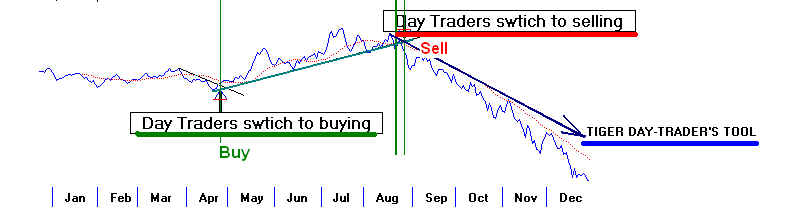
>4. changes in trends of the blue Tiger Day Traders' Tool.
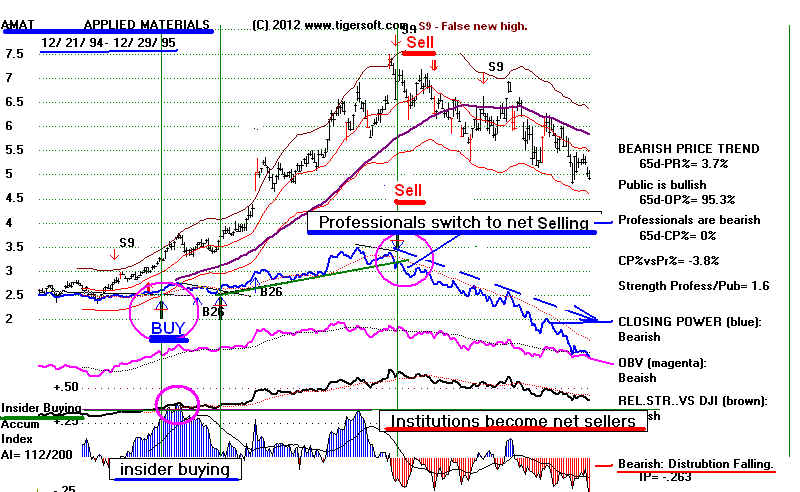
It is this UNREPORTED and UNOFFICIAL Insider Buying which gobbles up
the available float of a stock and puts it into tightly controlling hands that are not quick
to sell with only small gains and usually wait a year to sell. With the float reduced,
the stock can rise much more easily. It is this insider buying or selling which
Professionals become aware of and partake in, the buying often in a carefully
controlled way to prevent the stock from rising too much at first, so that they can keep
accumulating it.
We look for the signs of the unreported and unofficial Insider Buying by friends
and associates of the higher-ups in a corporation when the fortunes of their company
are about to improve dramatically. We spot this in the form of bulges from our
Tiger Accumulation Index above the +.375 threshold. Such buying should be
confirmed by buying by Wall Street Professionals, who typically quickly become aware
of any significant insider buying. Accordingly, the Tiger Pro-Closing Power, which
registers what professionals are doing, should turn up. In cases where a significant
stock rise becomes expected by Professionals, our Tiger Day Traders' Tool will
break its downtrend and start rising.
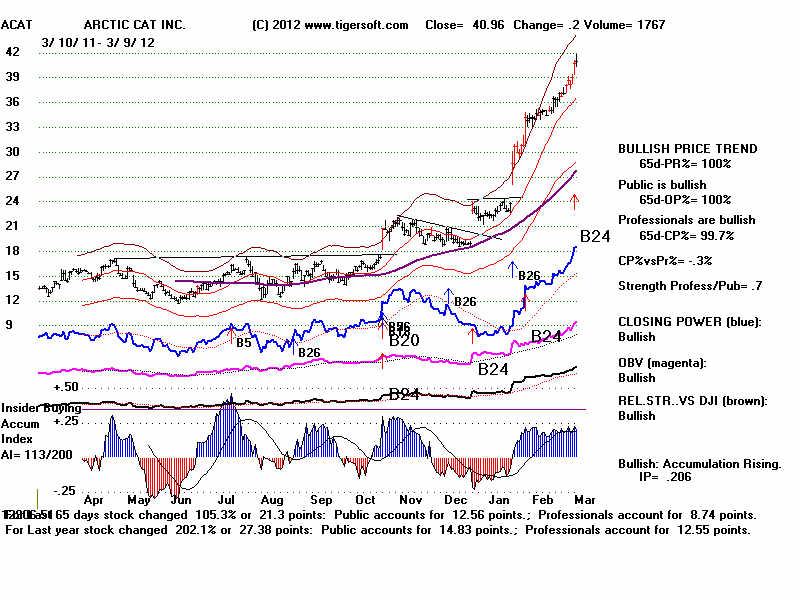
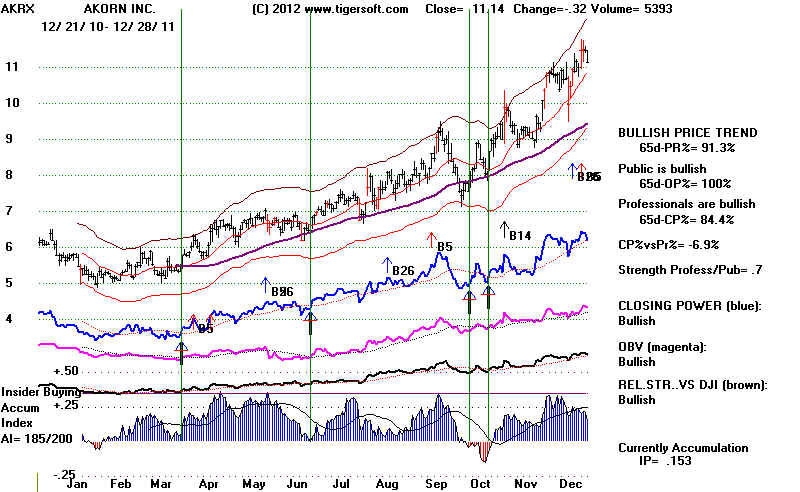
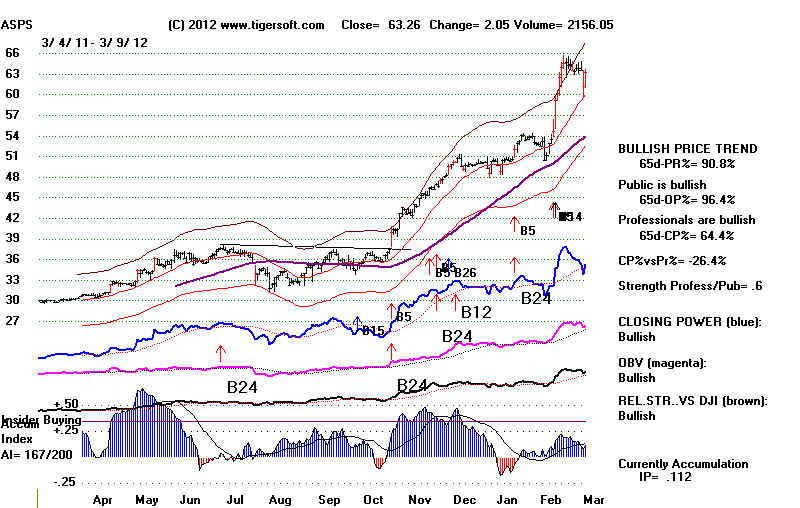
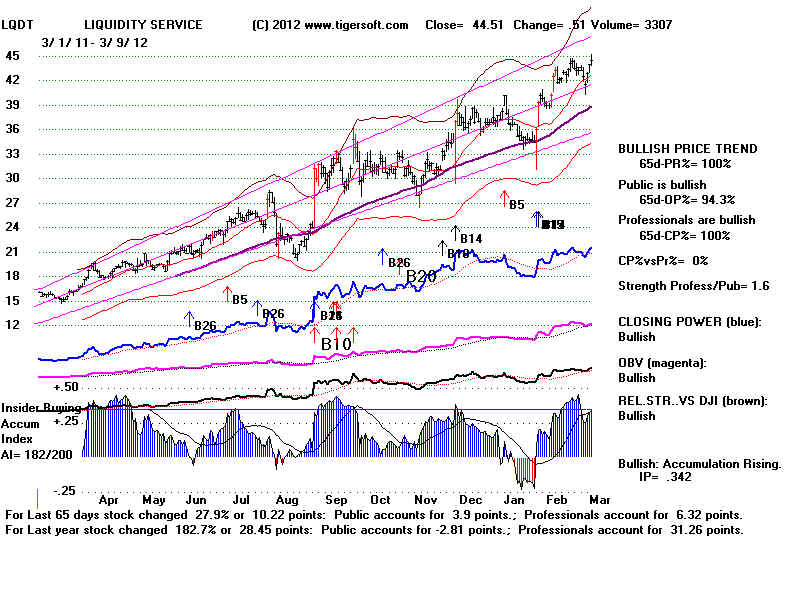
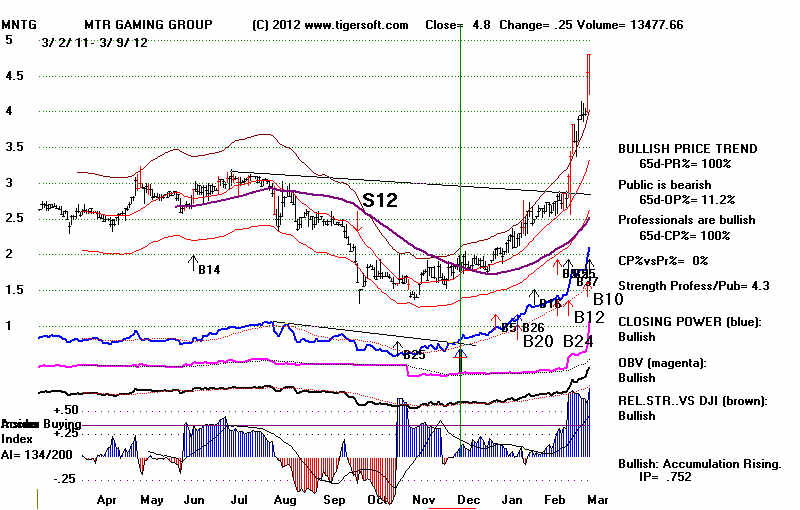
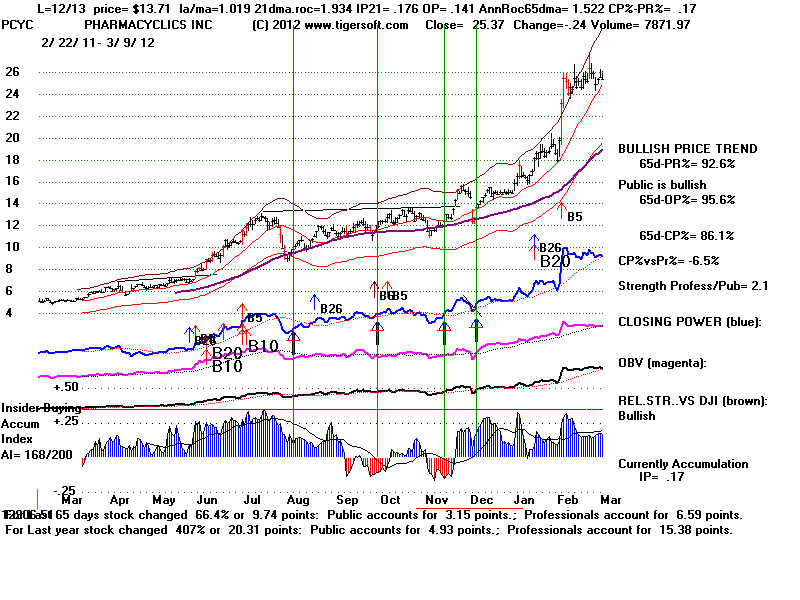
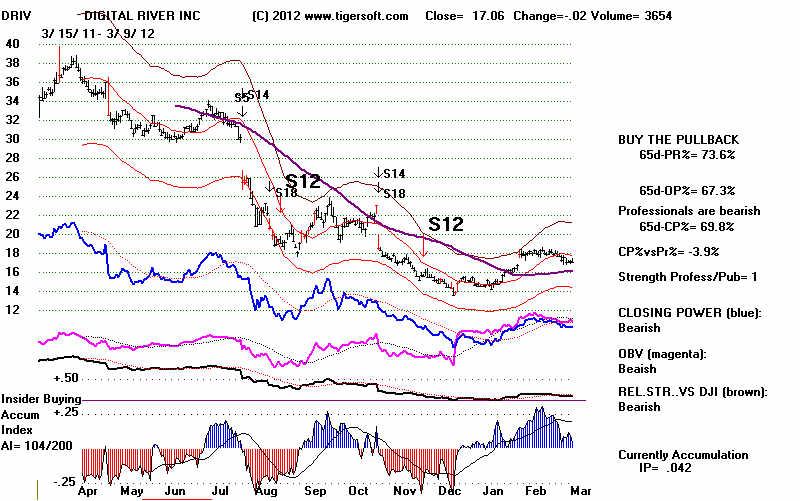
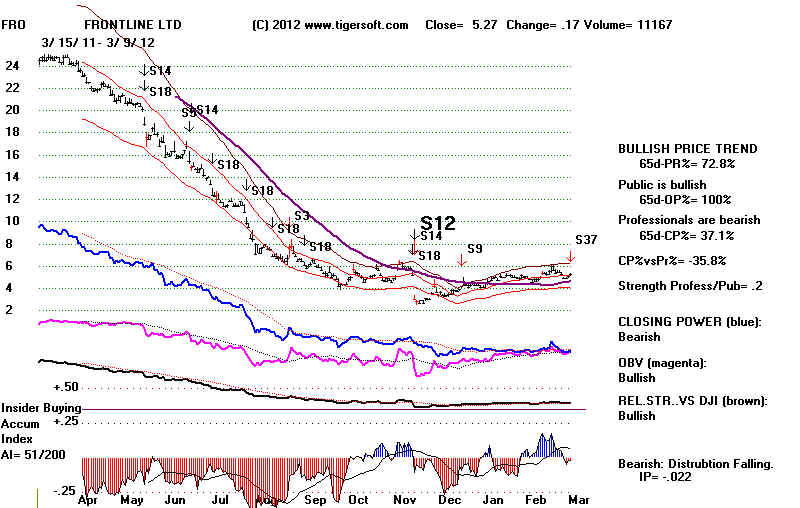
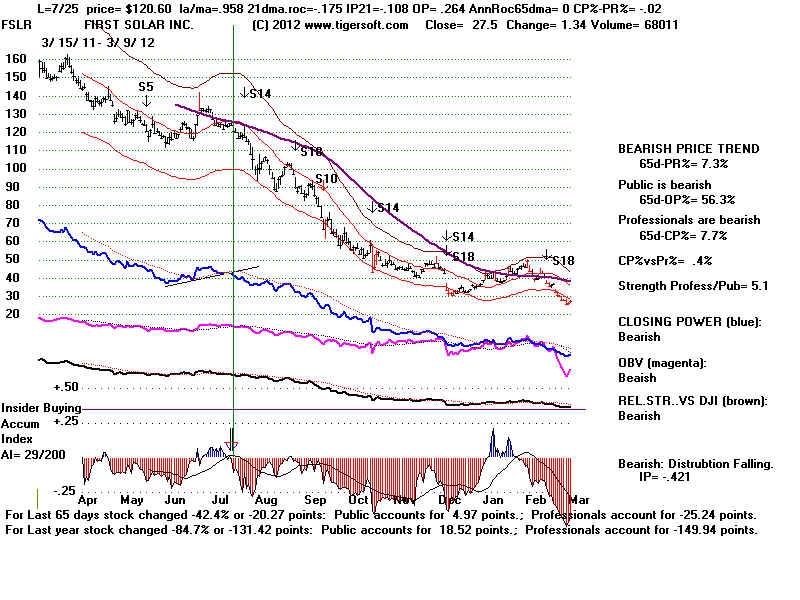
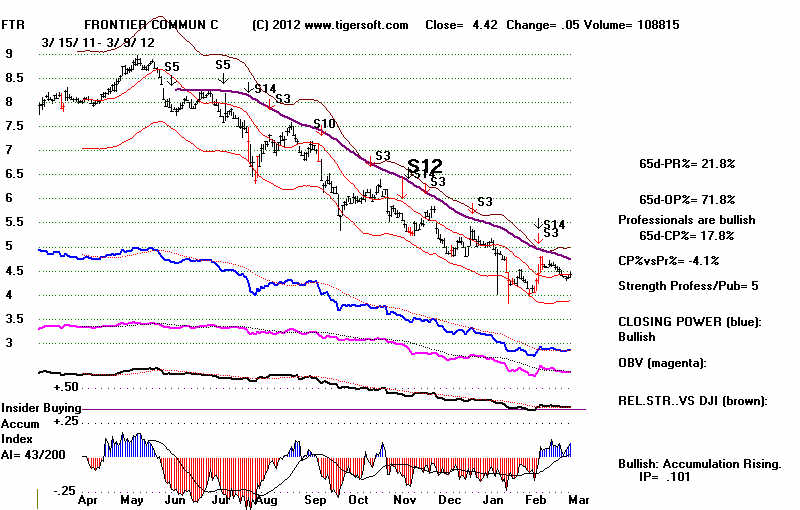
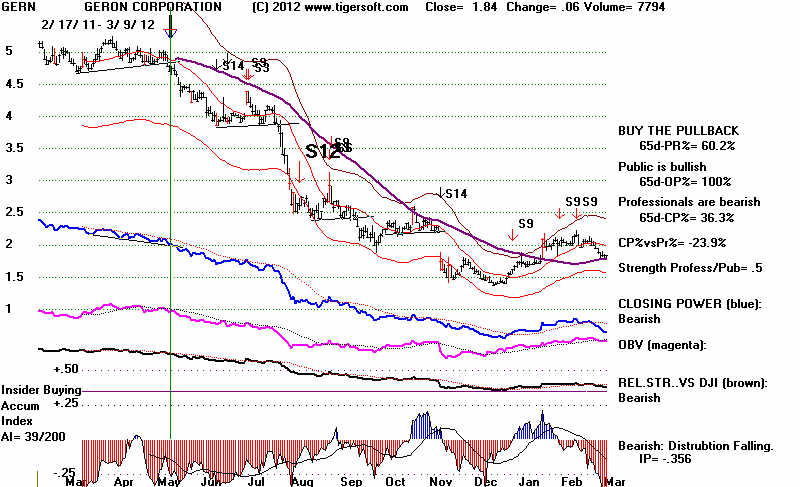
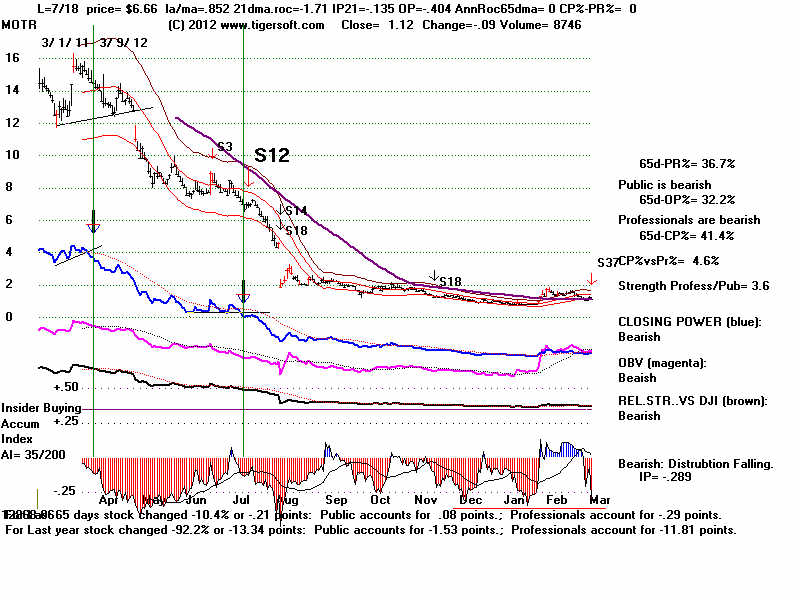
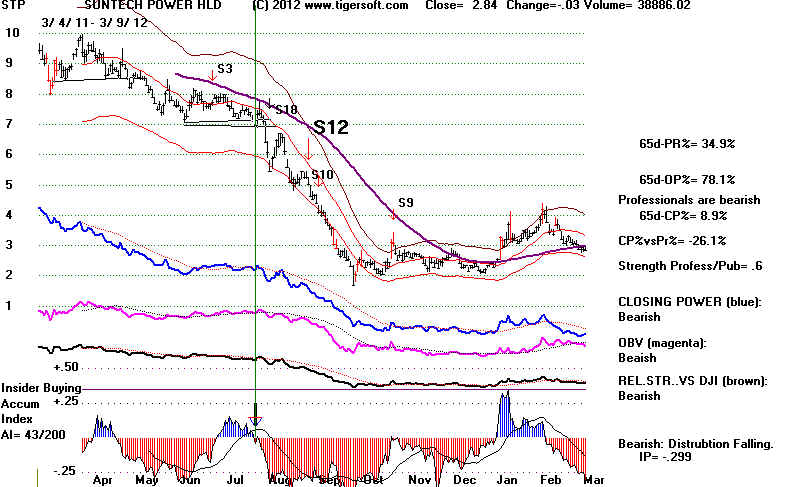
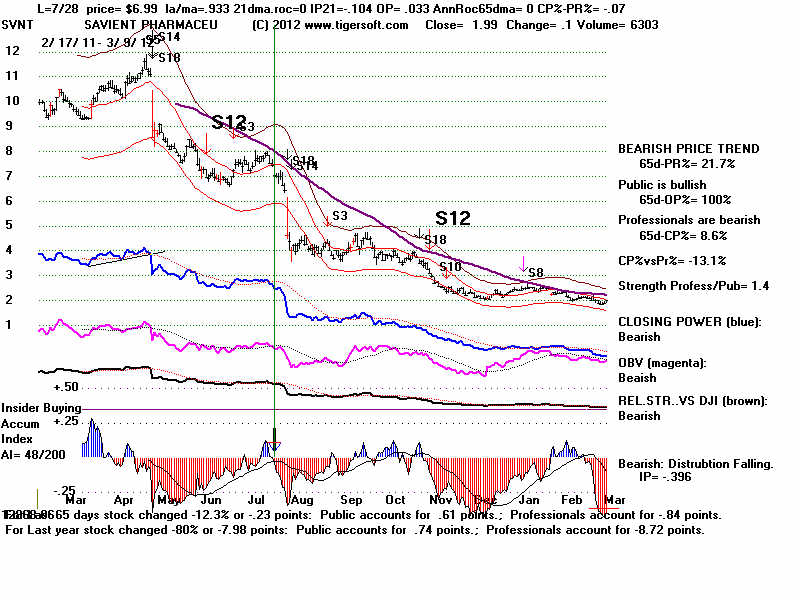
| Links to Explore: Explosive Super Stocks Killer Short Sales in Any Market Contrast the TigerSoft Charts of the biggest winners, ACAT, AKRX, ASPS, LQDT, MNST, MNTG, PCYC, SCSS with the biggest losers, ALSK, DRIV, FRO, FSLR, FTR, GERN, HL MOTR, RIMM, STP, SYNT Watch out for Heavy Scheduled Reported Insider Selling and Use TigerSoft's Closing Power To Know When To Sell. Insider Trading - "part of the fabric" and culture of Wall Street...It has become institutionalized." (NY Times 5/19/2012). Be A Whistle Blower on Inside Trading and Get Paid for It. |
Buy with The Insiders
Tiger Software's Power Ranker
searches for stocks to buy whose price up-trends
are confirmed by heavy (blue)
Accumulation and rising Closing Power. For purposes of
selling stocks short. we look for
stocks whose price breakdowns and downtrends are
confirmed by very negative (red)
Distribution and falling Closing Power.
We usually demand that
Professionals agree with what the Insiders are doing. So, we
trade the price waves up using the
TigerSoft Closing Power's turns upward from support
and the price waves down by
watching for signs that the Tiger Closing Power and the
Accumulation Index are turning down
again.
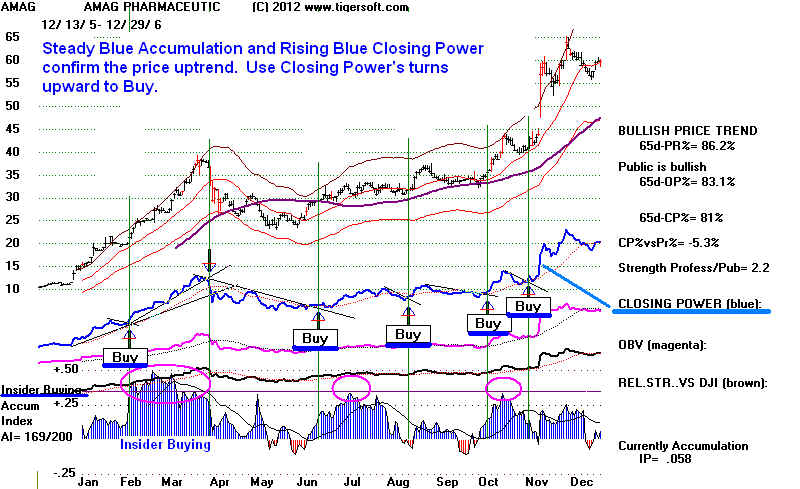
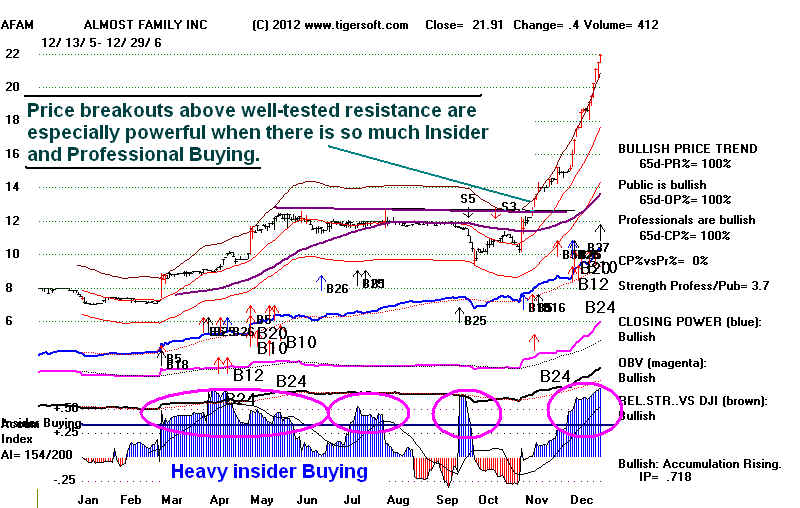
---> TigerSoft spots Insider Buying as spikes in our TigerSoft
Accumulation Index above
a key threshold which we have
extensively back-tested. See the many examples below.
The best way to trade such spikes
is with Tiger's Closing Power. Buy when the
Closing Power turns back up after
such a bullish spike of Accumulation. See this in
the chart below.
Selling
Short with The Insiders
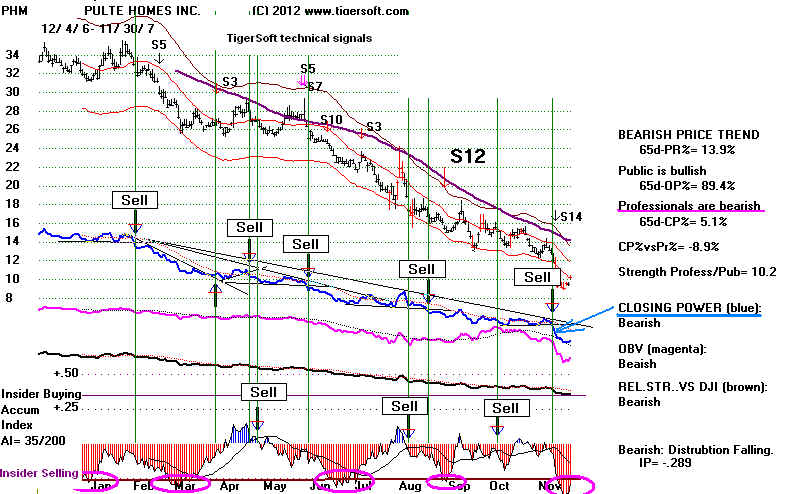
---> TigerSoft spots Insider Selling as deeply negative (red) readings
from our
TigerSoft Accumulation Index.
Greater price weakness than the Dow Jones is
normally required to take action.
too. When we see heavy red Distribution, we
short each new wave down. We
watch for Tiger Accumulation Index falling back
below its own moving average and
for the Tiger Closing Power violating its own
minor uptrend or
support.
Watch The Wall Street Professionals
using Tiger's Closing Power.
Market makers, hedge fund operators and
institutional professionals watch for
new developments that will impact
the companies they trade. They stay abreast
of significant scheduled insider
trading as reported by the SEC. They read the industry
journals and reports by Wall Street
security analysts. Their Washington representatives
tell them when prospective
government regulation changes or pending new legislation
will have an impact. We
should add that many of these Pros are not above
manipulating stocks by planting
news on Yahoo or CNBC to take advantage of
public fears and public
greed. So, we watch our Tiger Closing Power to see if they
change their minds about a stock,
regardless of what they may publicly say.
To see what they're really doing,
not what they say, we watch Tiger's Pro-Closing Power.
When it is rising, they are net
buyers. When it is falling they are net sellers. When
it changes direction, the
Professionals are reversing their position, from long to
short or short to long, and we
should think about doing the same, especially if
we see signs of insider buying or
selling from the readings of our Tiger Accumulation
Index.
Main Street is far away and those
living there are often the last to find out what is
really going on with a rising
stock. Seeing unusual patterns of insider buying, Professionals
make inquiries about the stock.
They exploit the network of informally exchanged
information that is Wall Street.
Usually, they discover the basis of the insider buying.
even when the Insiders have not
directly involved them, as they often do in the
case of mergers, takeovers, splits
and public offerings. These Professionals then
take positions in the same stock,
cover their short sales and trade predominately in the
direction that the Insider expect
the stock to move, using every advantage of leverage
the Federal Reserve gives them.
HOW TIGER IMPROVES
GREATLY UPON THE AXIOM,
"BUYING ON THE RUMOR AND SELLING ON THE NEWS"
Just about every study of stocks and even
cursory reviews show that "Insider Buying"
quite commonly appears in a stock in the
months, days or weeks before it makes a big price
advance on a bullish public announcement
(i.e. stock split, good earnings, new discovery,
takeover, public subsidy, etc.).
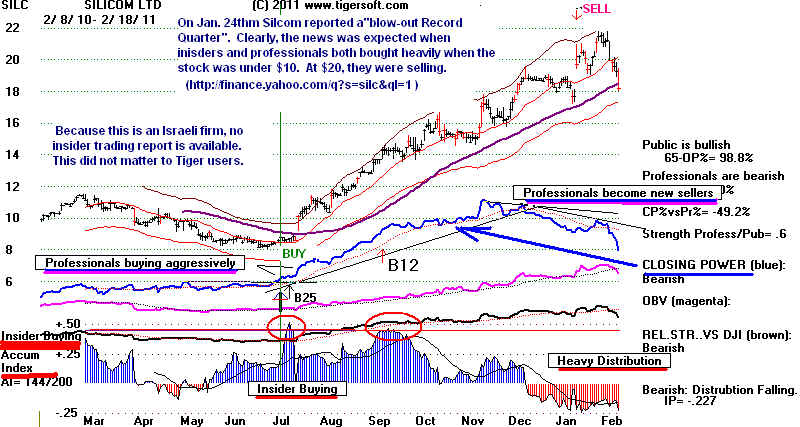
Insiders and Professionals got a quick double out of SILC
shown above.
Not surprisingly, the stock sold off with heavy (red) distribution and falling (net
negative)
Professional Selling at 20 when the
news came out. This is exactly why cynics say
"Buy on the rumor and sell on
the news". Actually, this axiom has a long history,
because insiders and professionals
have been playing this one-sided game a long time.
For example, on December 13,
1956, the NY Times wrote "In the Bethlehem-Youngstown
situation, Wall Street held to its
old apothegm, “Buy on the rumor,
sell on the news.” This
expresses the often observed fact
that stocks involved in merger negotiations do considerably
better than the market as a whole
between the time the merger is first rumored and the time
the companies announce it, and
considerably worse between the announcement and the
consummation."
Some go so far as to say: "always" buy before there is any public announcement
of
a company’s earnings.
By the time the news is published, it is too late to buy, they say.
Too many savvy traders will have
already anticipated the news by hearing about it from
insiders, from fellow-stock brokers
or their associates, by in-depth research or, perhaps,
by observing the stocks unusual
price behavior and buying. Moreover, insider trading is
now so widespread, they insist,
that it's best to always automatically sell on good news
when the stock is probably up.
Such advise is problematic. The first problem with such approach is that there are
always about a million
semi-plausible rumors floating around. How does one decide
when a rumor should be acted upon
or which is the rumor that might turn out to be true?
Should we always Sell on the news?
We think always selling on the news is a mistake. Some of the news is truly
not widely anticipated. Often
still better news is going to come out. Without TigerSoft's
Professional Closing Power to show
whether Professionals are actually jumping ship
and are c;learly net sellers. the
Selling part of the axiom is probably a pretty good idea.
See: http://www.barrypopik.com/index.php/new_york_city/entry/buy_on_the_rumor_sell_on_the_news_wall_street_proverb/
But we at TigerSoft would rather just
let the Professionals, using the trend of the blue
Tiger Closing Power, tell us
whether we should sell, hold or perhaps buy more.
Sometimes, Professionals do
sell. But sometimes they are still heavily buying. So, we
always watch the trend of our
Tiger Closing Power. In addition, we have formulated some
trading strategies that use the amount of insider buying to tell us how long to expect
optimally hold.
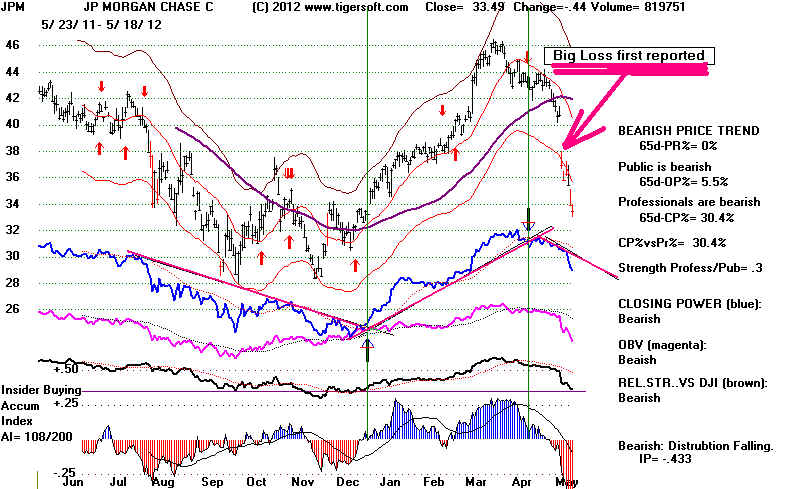
Example: We were initially
told JP Morgan's trading loss in May 2012
was more than a $2 Billion by its CEO. The stock kept falling. Then it
was disclosed that the
loss would be more than $3 billion. The the Wall Street
Journal reported it could
reach $5 Billion. Most recently, we are told
the loss will be as much as $7 billion. Who knows? To trade it, all we
had to is watch the falling Blue Closing Power and stay short until the
Closing Power downtrend broke its downtrendline. The Professionals,
as represented by the Tiger Closing Power, will tell us when the
stock has bottomed and the news, in fact, is not getting worse.
THE MORE
ACCUMULATION, THE MORE BULLISH THE STOCK,
PROVIDED PROFESSIONALS KEEP ON BUYING, TOO.
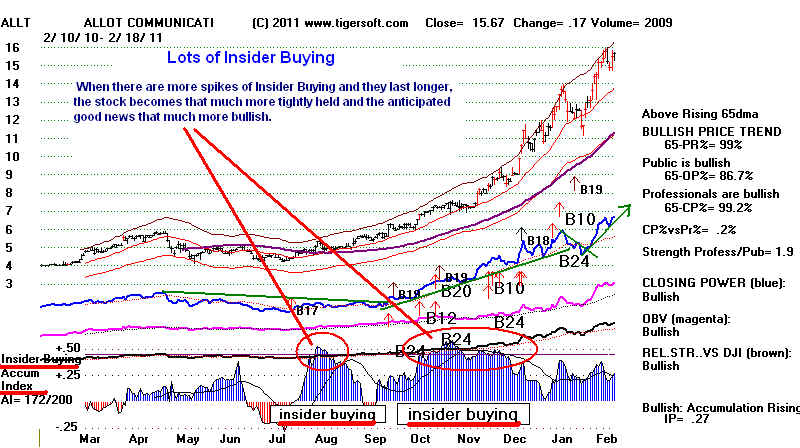
When there are more spikes of
"Insider Buying", as we measure it, and they
last longer, the stock
typically becomes that much more tightly held and the anticipated
good news that much more
bullish. Such situations also produce more automatic
Buy signals. ALLT shows
much more insider buying than SILC and, so, we would
expect it to outrun to upside
the first or even the second good earnings' reports
as the stock moves up.
The
announcements about ALLT show: improved earnings
were reported on
November 9, 2010, but even better earnings were reported on February 8, 2011.
Selling in November would
have meant missing the best part of the rally to date.
ALLT is also an Israeli
firm. If we tried to rely upon reported Insider trading transactions,
we would not have bought this
stock. Clearly using TigerSoft, made it easy to see all the
heavy Accumulation in ALLT's
case. With such stocks, we expect bigger moves
and it has paid off.
Sometimes, the Insider Buying
continues for month after month, always
with it confirmed by a
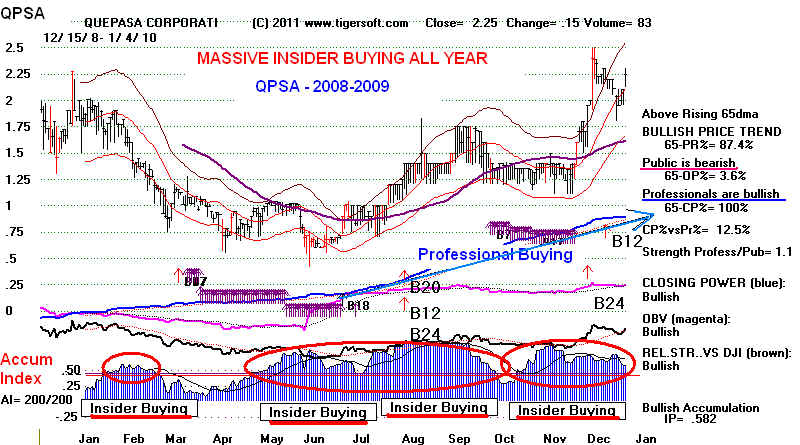
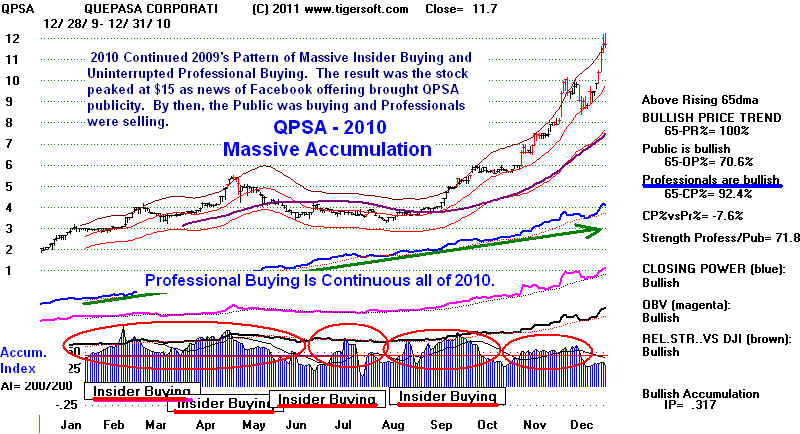
rising trend in the Tiger Closing Power. QPSA was
bought by us initially
at $1.60 in December 2009. See how the Accumulation
stayed very high for
most of that year and the following year, too. As long
as Professionals were
net buyers and the Tiger Closing Power kept rising,
we held or bought more.
Eventually, in January 2011, QPSA peaked at 15,
after moving from the
pink sheets to the American Stock Exchange and getting
lots of bullish
publicity for being the Spanish language equivalent to Facebook.
INSIDER SELLING
CONFIRMED BY PROFESSIONAL SELLING
MAKE AN EXCELLENT SHORT SALES
It should go without saying,
but all our studies and most others, too, show that
"Insider Selling"
occurs quite commonly in stocks that will soon fall precipitously
on a bearish public
announcement (i.e. sharply lower earnings or lowered estimate
of future earnings, law suit,
governmental investigation or bankruptcy).
In most cases, there is also a pattern of official or reported insider selling. What
counts most is that
Insiders and Professionals are both very bearish. See below
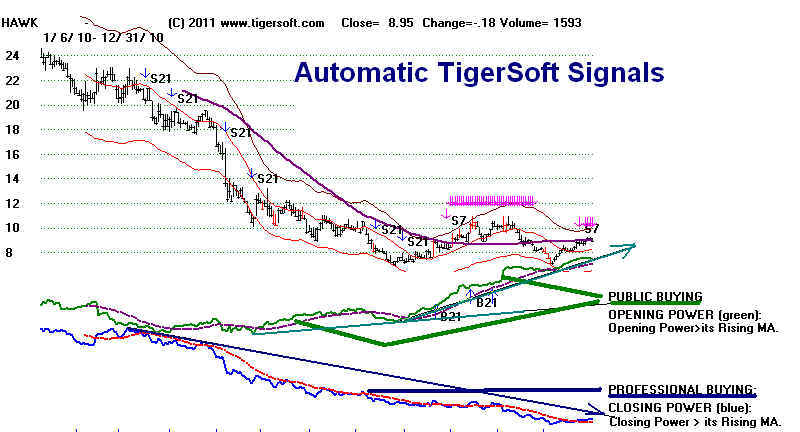
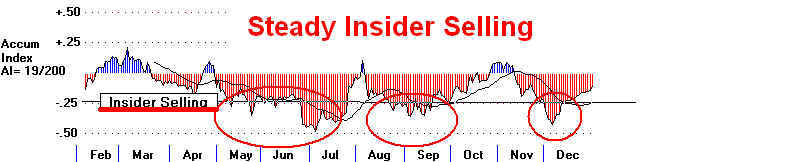
in the case of Seahawk
Drilling (HAWK) how the Tiger Accumulation Index stayed
s negative (red) and
frequently falls below -.25, our provisional threshold for signifying
important unofficial
and official insider selling when Tiger's Closing Power confirms
the trend. We
want Wall Street Professionals to confirm the insider selling. The price
decline was remarkable,
because this was a period of rising stock and oil prices.
See how the blue Tiger
Closing Power kept falling and falling, all the while the general
Public were fooled by
the apparent "cheapness" of the stock and steadily buy all the way
down, judging from
Tiger's Public Opening Power.
The behavior of the Tiger Internal Strength Indicators is quite typical when very
bad news is about to
befall a stock. Insiders do not tell the public the bad news,
before they themselves
sell. Though this is a violation of their fiduciary responsibilities
to their shareholders
in a publicly traded company and even though they pay
themselves enormous
salaries and bonuses, they seem too greedy to give their
shareholders a fair
shake. They and their friends always seem to help themselves first.
They sell before they
let the bad news out. We can always count on their greed
and the lack of SEC
enforcement to tell us what to sell short. Compare SEAHAWK's case
below with the insider
selling by Peter
Sperling, CEO of Apollo. Or the bankers' insider
selling at CitiGroup or Washington
Mutual long before their stocks plunged into the abyss
because of the
recklessness of their use of leverage in the mortgage debacle of 2008-2009.
SEAHAWK's PLUNGE INTO BANKRUPTCY
WAS
ANTICIPATED BY ITS INSIDERS AND WATCHFUL PROFESSIONALS
We think these concepts and our practical measures for identifying
Insider and Professional trading are the most important keys to your making |
big
money in stocks that you will find... Certainly, I have found nothing like
this
since1967, when the author first began reading about the stock market
in
the library of Columbia University's Business School..
Read more. Visit as long as you
like at our Main Web-Site www.tigersoft.com,
our TigerSoft Blog
and Daily
Comments on News with TIger's Insider Trading Charts
and TigerSoft's
Keys To Tracking ALL Insider Buying and Selling.
Then
get TigerSoft
or subscribe to our Nightly
On-Line Hotline. You'll wish you had
gotten Tiger years ago.
==================================================================================
MORE EXAMPLES OF INSIDER SELLING
Don't Get Mad, Get Even!
There
are so many examples of what should be illegal insider selling. But
crystal clear are the cases of WAMU's Killington and Rubin's CitiGroup.
See also the Blog I wrote in late 2007, long before these stocks collapsed.
December 30, 2007 Insider
Selling at Washington Mutual and CitiGroup
Should
Make Shareholders "Mad as Hell".
It predicted WAMU's bankruptcy and exposed Killington's
insider
selling, based on how extensive the insider selling was.
The
TigerSoft chart below shows you exactly what to look for.
TigerSoft Rules Are
Simple:
>>>Intensive Negative (Red) Distribution in Tiger's Invention,
the Tiger Accumulation Index, Means Insider Selling
>>>The steady red AI readings show heavy Institutional Selling.
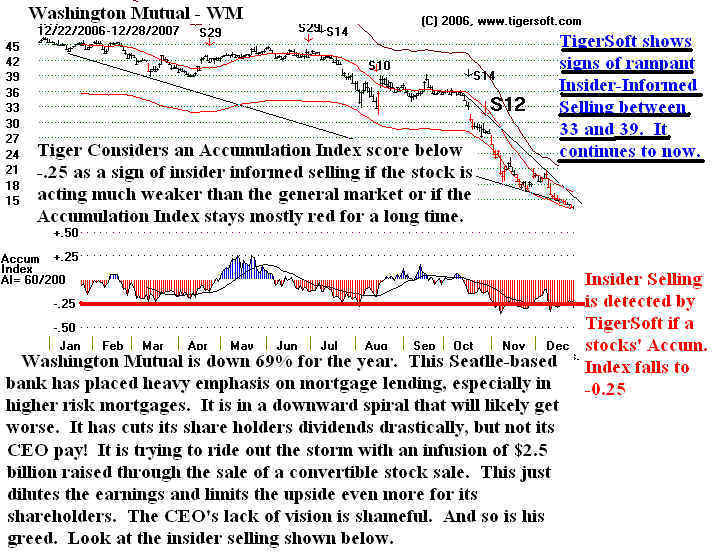
>>>Sell these stocks short on rallies that fail. Our automatic signals
show you when.
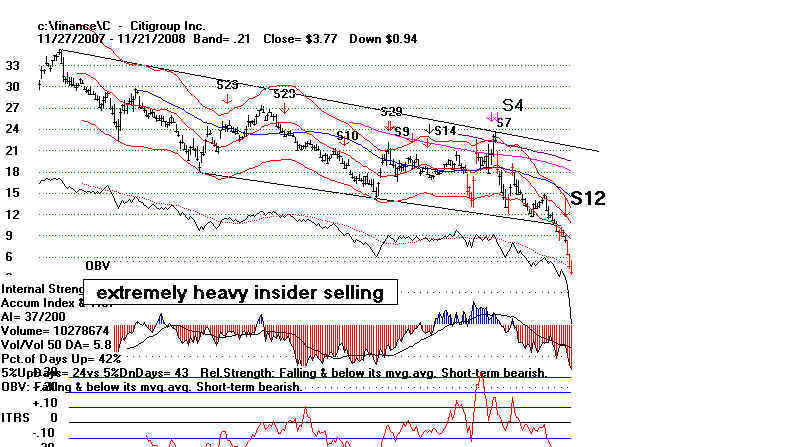
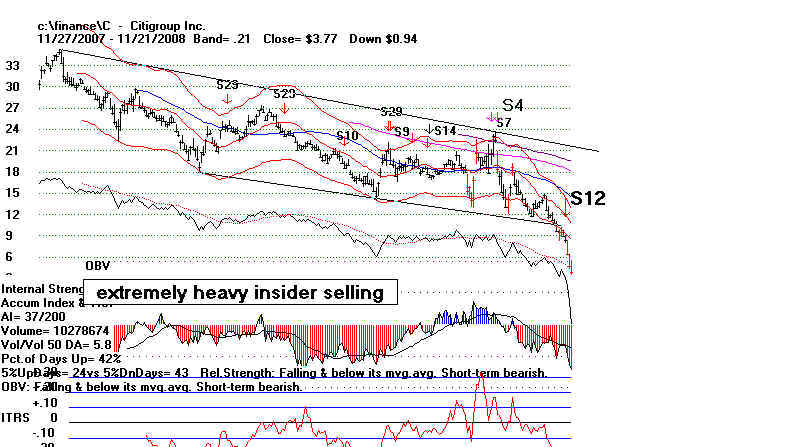
Rubin sold millions of Citigroup stock at it top near 55. As it fell, down,
down, down, it might have looked cheap. But it hit ONE DOLLAR.
It was never cheap enough!. Don't rely on emotional hunches to buy!
Watch the insiders. What what they do
with their own money, not what they
say to the media..
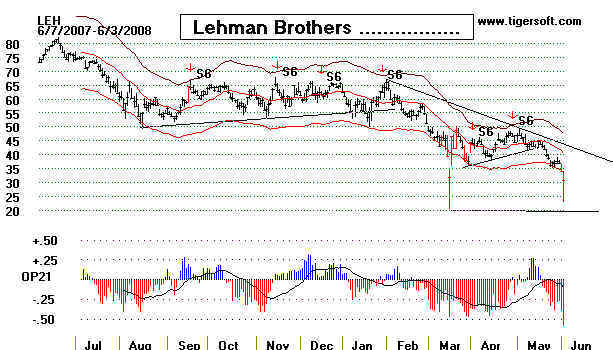
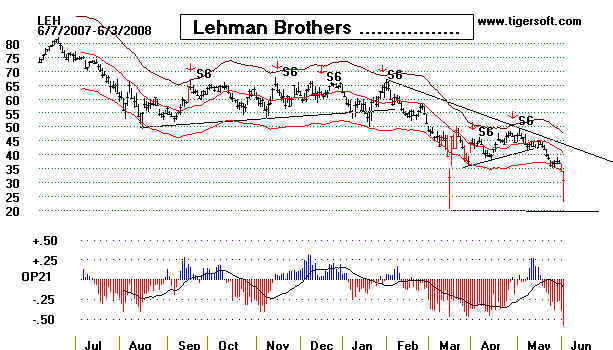
LEH on the road to
bankruptcy!
 For more examples of insider selling, continue reading and see -
> Let TigerSoft Find Killer Short
Sales.
> 2010's
Worst Performing Stocks
> December 26, 2007
Insider Selling:
British Style. Is Northern Rock The Tip of The UK Ice Berg?
MORE EXAMPLES OF INSIDER
BUYING
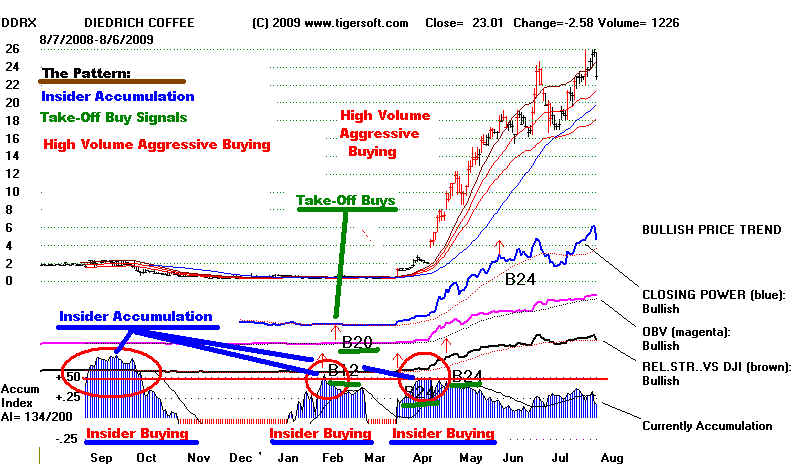
Again, Apply The Simple TigerSoft
Rules:
>>>Intensive Positive (Blue) Accumulation in Tiger's Invention,
the Tiger Accumulation Index, Means Insider Buying
>>>The steady blue AI readings show heavy Institutional Buying
Buying with the insiders from March to
July 2009 proved ideal,
just as we predicted it would at the time. Please look at some of the stocks
our software found for customers to buy back then. They were exactly
what we have been looking for since 1990s when we formulated the rules
for the major Buys you see on this chart. Please go to the link below.
June 6, 2009
The Great 2009 Bull
Market.
Why Is Wall
Street Concealing The Huge Surges in Low Priced Stocks?
DDRX was finally bought out at 35.
For more examples of insider buying continue reading and see -
> Let TigerSoft Find The Next
Explosive Super Stocks.
> 2010's Best Performing
Stocks
HOW TIGERSOFT TRACKs ALL INSIDERS
TigerSoft's Keys To Tracking ALL Insider Buying and Selling
Besides official insiders, Tigersoft profitably also tracks the insider-informed
stock trading by the associates of Corporate Insiders and ALL Key
UNREPORTED Insider-Informed Buying and Selling by Wall Street Professionals.
Advance information about buy outs. secondaries, splits, earnings, bond
issues always either leaks out in advance to someone in the company and
their friends and business associates. It is often deliberately leaked to the chose
few on Wall Street in order to get favorable treatment in brokerage recommendations
and analysis. The SEC cannot change this. So, use TigerSoft. Level the
playing field.
>Our tools uniquely contrast
Professional and Public Buying and Selling.
>Tiger screens All Stocks for key
levels of insider and professional
Buying and Selling.
How TigerSoft Flags
Savvy Insider Buying
We at TigerSoft are
privy to no insider tips or secrets. But over the
years, we have learned how to spot savvy insider trading that is
about to send the stock up and up and up! This pattern of buying
repeats over and over again, year after year, in all markets, because
someone on the inside knows something very good will happen to a
company in the not too distant future. They know this with a certainty
that is reflected in their manner of buying.
The Four Key Stages To Watch for
First, they quietly accumulate all the shares they can. A weak general
market environment makes this a relatively easy pursuit. See the
tell-tale bulges in the
TigerSoft Accumulation Index
in the chart below.
When no more shares are available this way, they become more
aggressive, because they know there is a very high probability that
the stock will be much higher in six months or a year. We spot this
stage technically, using our Accumulation Index, price patterns, volume
and the automatic Buy signals which we have back-tested for the
this purpose over more than 30 years of time with thousands of stocks'
charts.
Thirdly, because the stock is tightly held and the insiders have been
quite shrewd, prices rise
very sharply on high (red) volume, as more
and more professionals and a handful of public speculators jump aboard.
Fourthly, watch to see if the Professionals agree with what Insiders
are doing. We want to buy stocks showing high levels of insider buying
and an up-slanting blue Tiger
Professional Closing Power.
Our Hotline
post these "Bullish
MAXCP" stocks' Tiger
charts for your inspection
each night, along with the opposite appearing stocks, those with heavy
red Distribution and a down-sloping Professional Closing Power that
is weaker than the stock's price action. These are the "Bearish MINCP stocks".
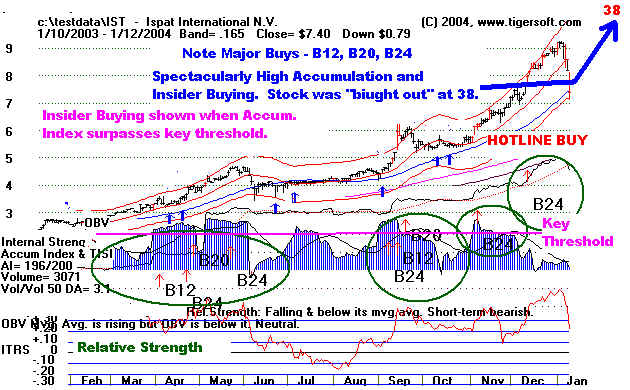
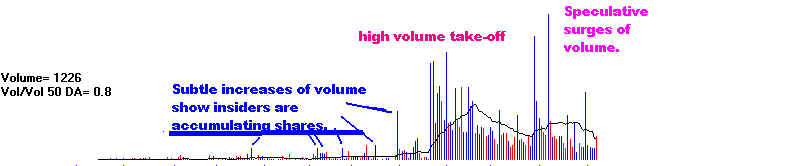
If you look closely, you can see all this in the DDRX chart below.
In particular, see how our TigerSoft Accumulation Index spots the
earlier periods of insider accumulation by rising above the +.5 threshold.
The indicator varies from -1.0 to +1.0. It is quite bullish that there were
three periods when it rose above +.50. A lot of stock was accumulated.
The many automatic Buys are our alerts to buy the stock. The rising
prices show us we were quite right; this was very savvy insider buying.
Who were the insiders here? Sometimes, you can tell by looking
at
the official inside trading records that corporate insiders must report
to the SEC. More often, there is no easy way to know. But make
no mistake about it, someone on the inside knew. That's why the
trading patterns matched so exactly the model we have constructed
to spot savvy insider buying. .
Wall Street's 'Dirty Little Secret'
INSIDER TRADING IS RAMPANT!
I have been writing for four years about
how the SEC
is worse than useless and toothless, because it still gives
the least informed members of the public the dangerous illusion
that there is a governmental agency effectively policing and
preventing investment fraud and insider trading. There is
so much proof of how rampant is insider trading that one hardly
knows where to begin to discuss it. And, with each new day
more examples emerge, along with governmental officials
decrying the state of affairs.
The US law itself seems clear. While corporate insiders,
key employees, directors and officials may buy or sell their
company's shares, they must not do so based on material
non-public information about their company and when they
do make a trade, they must report it to the SEC, which then
allows the public to see what they are up to. If insiders do
make trades based on non-public information, the trades
are considered fraudulent and the insiders are judged to
have violated their fiduciary responsibilities. In addition,
trades made by insiders tips to friends and associates are
illegal. Again, the insider's duty to public shareholders is
considered to have been violated by such tips. Stock brokers,
analysts and journalists who in the course of their duties, discover
and then trade upon non-public information that materially affects
a company's stock also break the law, if they "had
reason the
believe
that the tipper had breached a fiduciary duty in disclosing
information"
Federal Court decisions have further clarified what the law
considers insider trading. The SEC v. Texas Gulf Sulfur (1966)
is the most important case in setting the law. TGS found an unusually
rich deposit of ores near Timmins, Ontario. Initially, the company
issued discouraging press releases about the discovery, all the
while several directors for the company loaded up on call options
and stock. The press releases were meant to dupe the Canadian
farmers into selling or leasing their land at a fraction of its probable
values.
The 1934 Securities and Exchange Act gives the SEC the authority
to demand that violators give up their trading profits. They may
also ask a court to impose a penalty of up to 3 times the profit
realized by their insider trading. The sane law gives the US Justice
Department the authority to bring criminal prosecutions against
inside traders. In 2002, an inside trader could be given a 20-year
jail sentence and be fined up to $5 million. In practice, criminal
penalties are rarely sought, except in a few high profile cases. As
a consequence, such penalties act as very little deterrent.
Unfortunately for investors, the SEC acquired a reputation between
2000 and 2008 of being all but toothless. Too often they decided, while
the trading may have looked suspicious, it would been too hard
or too politically inconvenient to prove that the insider trading was
done because of illegal use of non-public information. The weaker
the SEC's enforcement looked, the bigger the problem became.
In August 2006, the NY
Times ran a lead story on page 1 that Wall
Street insider trading had "gone wild". "41% of all mergers worth
$1 billion or more over the last 12 months show signs of insider trading
ahead of the deals."
On October
26, 2007, the NY Post quoted a senior SEC official as
saying that insider trading was "rampant"
among Wall Street professionals.
"I am disappointed in
the number of cases we are seeing by people who
make an abundant livelihood in the market..."
In another example, a 5/18/2008 GA0 (Government Accounting) report on the
SEC wrote:
"In one case, an
enforcement attorney told the GAO that a
company offered to pay $1 million to settle a case, but the attorney
recommended no penalty because "they did not believe the commission
would approve the company offer."
See -
http://www.star-telegram.com/business/v-print/story/1380769.html
John Mack, the CEO of investment bank, Morgan Stanley is
apparently above
the law. Gary Aguirre, a former
SEC investigator, told a Congressional committee
that he was fired when he tried to
interview Mack about tipping off the
hedge fund Pequot Capital Management
about a 2001 merger deal between
GE Capital and Heller Financial.
Pequot netted $18 million in profits
from the tips. A Congrsssional
Investigation was launched. It
ended up
siding
with Aguierre against his bosses at the SEC
In July 2009, the
Seattle Times noted that the SEC typically goes after the small fries
for insider trading, while well placed insiders and institutions often get off without
even a warning. Insider trading, the articles concludes is rampant. Even former
SEC Chairman Cox admitted this: "There is ample
empirical evidence that there is
significant trading in securities markets on the basis of secret advance knowledge".
Flagrantly Illegal
insider Trading is rampant and commonplace. This is the
inescapable conclusion we reach looking at all the evidence. The SEC exists mostly
to
give the appearance of fairness for all investors on Wall Street. Insiders sell out
on
when
false, exaggerated and distorted "good news" comes out that they know will soon
turn
bad. Earnings and earnings' estimates cannot be safely trusted.
After-the-fact
discoveries of "Cooked Books" and CEO Lies and cover-ups are very common.
Since 2001, the SEC has prosecuted
about 50 cases of insider trading per year.
That is not nearly enough to stem the tide. Insiders who use a modicum of discretion
have no fear, especially if their gains are not out of the ordinary. The SEC picks a
minute
number of high profile individuals to prosecute for insider trading. This is for
show!
99.9% of the other cases where big gains are made flagrantly using insider trading
are ignored. The prosecution of a very few well known people is done for public
consumption, to make it seem that the SEC is protecting the public. This was
mainly true
in the Clinton Administration, too.
Certainly, the SEC rarely goes after the biggest investment banks, where so much
of the insider trading takes place. Look at the steadily red negative readings from
the TigerSoft Accumulation Index, for example, in Citigroup. These were
insiders
and their friends selling out. Even using the official records, insiders sold 1 million shares
in 2007 at or near the top!
See Tiger Blog 11/25/2008
RECKLESS
CITIGROUP INSIDERS SOLD 1,000,000 SHARES IN 2007.
Now taxpayers are bailing out
the company with more than $45 billion.
Why does the SEC not go after insiders like these?
Why not Kellinger (Washington Mutual) or Rubin or Prince (Citigroup)?
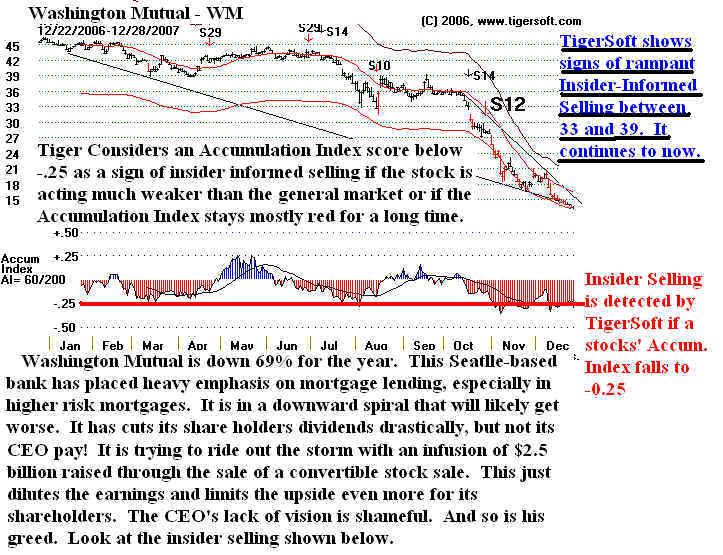
Just below is the WM chart I put on our Blog for 12/28/2007, nine months before I
warned it might go bankrupt, based on how extensive the insider selling was.
The TigerSoft chart shows you exactly what to look for.
See also
- SEC charges Mark Cuban
with insider trading... He is the best known figure to be accused
by the SEC since its 2002
case against Martha Stewart. - Sacramento News ...
- The Undercurrent | insider
trading (April 6, 2008)
- A Financial History of
Modern U.S. Corporate Scandals: Since Enron
- Insiders
circumvent insider trading regulations...
Insider selling is
rampant and goes unpoliced. The
evidence is in the TigerSoft
charts. "Someone always knows", we say. Use the TigerSoft charts to see if
insiders are buying or selling and you will do very well in the stock market.
The Scandals of ImClone, Enron, Arthur Andersen, Health South, Homestore.com,
K-Mart, Martha Stewart, Merrill Lynch, Qwest, Jack Grubman of Smith Barney,
Tyco,
US
Technologies and WorldComm are the tips of the ice berg. They have just whetted the
appetites
of a new generation of Corporate CEOs, Presidents and Board Members.
Some history, lest we
forget.
IMPORTANT: "Fortunately, savvy TigerSoft users can readily spot what Big
Money
and Insiders are doing with their own money. It is only when we buy when they
buy and sell when they sell, altogether disregarding what CEOs say, that we can make
some real money." William Schmidt, TigerSoft
Check back here for More Studies.
See NY
Times List of Insider Trading News.
Another possible source of data on insider trading is http://www.biginsiders.com/index.php
 InsiderTrading Studies by
TigerSoft
InsiderTrading Studies by
TigerSoft"Insiders always know in advance."
Never forget that phrase. Let TigerSoft show you how to reap the rewards that come from closely
following the tell-tale signs of insider buying, insider accumulation, insider selling and insider distribution.
See below for more details.
$75 - TigerSoft Books by William Schmidt, Ph.D. (Columbia Univ.)
"How To Spot Insider Selling and Make Killer Short Sales in Any Market"
===> Order Book
"Explosive Super Stocks: How To Spot Them at The Start of Their Move:
The Conditions That Launch Each Year's Biggest Gainers and Then How Not
To OverstayOne's Welcome." --> Order book.
"Tiger's Tahiti System: 24.4%/Year: 1970-2007: Buying The Most Accumulated
DJI-30 Stock." -> Order here.
TIGERSOFT STUDIES OF INSIDER TRADING
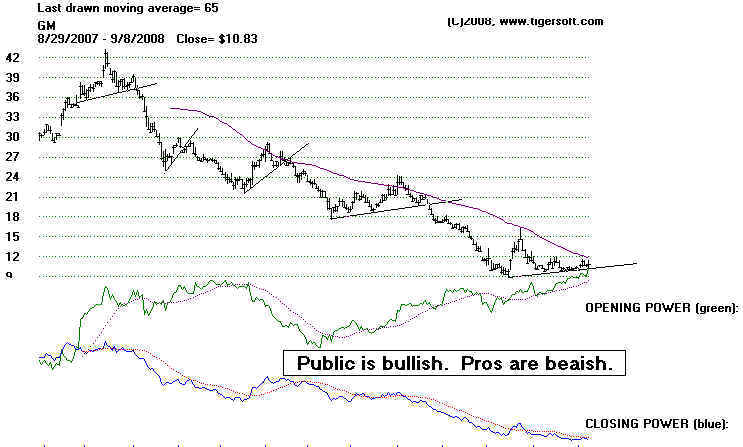
>>> 11/25/2008 Easily Spot Key
Insider Selling Using TigerSoft. Compare The Insider Selling
Shown on The
TigerSoft Charts of Citibank with Those of Bear Stearns,
Lehman Brothers,
Washington Mutual, Freddie Mac, Fannie Mae, Trump,
Northern Rock and
General Motors.

>>> November 21, 2008
Four Phases of A Typical
Speculative Stock:
Take Off, Topping Out,
Collapse, Base Re-Building.
Examples of DRYS and TASR.
>>> June 4, 2008 Far from Over, The
Credit Crunch Is Worsening:
Charts Showing heavy distribution: NEXC, ABK, MBI, LEH, FCFC, CORS, CCBO
CNB, WM, IBCP, GSBC,
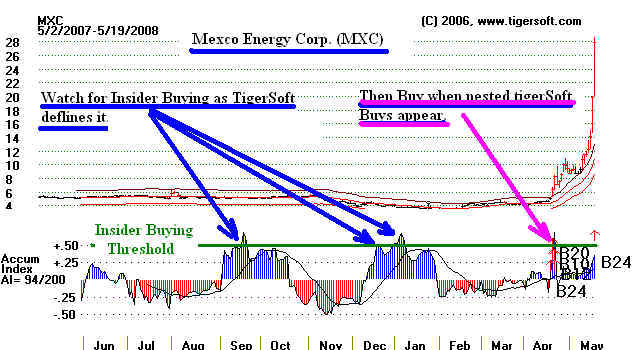
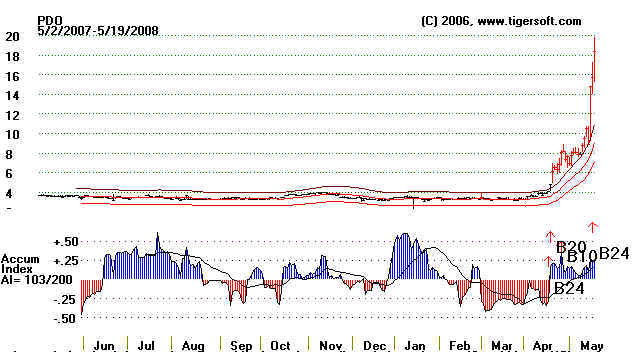
>>> 5/20/2008 Oil Stocks: TigerSoft
Charts show how Insider Buying put us on high alert
in the year's biggest
gainers.
The cases of MXC, PDO, ROYL, GENC and MPET
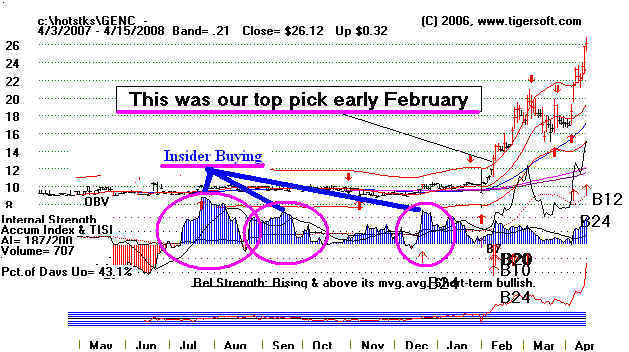
>>> 4/13/2008 Significant Insider
Buying - as Tiger defines it - is present in best
performing stocks
of the last year. This
is true in every study we do. is Dey
>>> 3/16/2008 Insider Selling at
Bear Stearns
>>> 2/26/2008 Big Money Accumulation
in Food Commodities.
>>> 1/24/2008 JPM
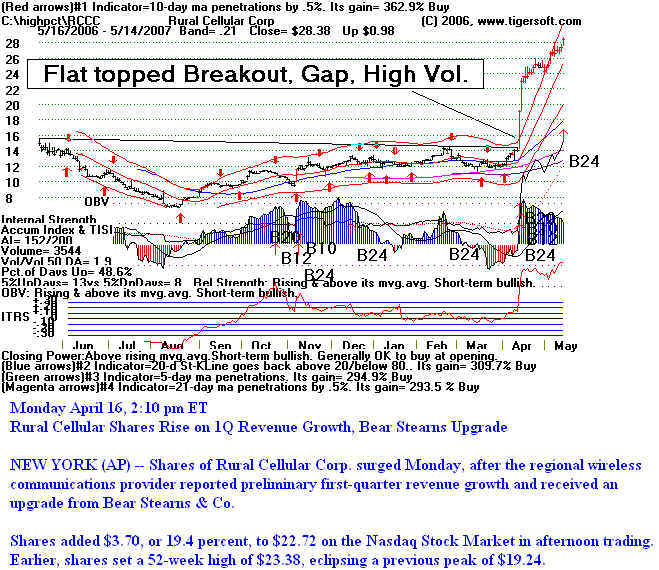
Morgan and Rural Cellular.
We detect insider buying by the Accumulation Index surpassing .50.
Notice the bulges in November and April below...
More examples - http://www.tigersoft.com/Tiger-Blogs/12-31-2007/index.htm
>>> Schering
Pl;ough Accused of withholding data showing its anti-cholesterol drug, Vytorin, is no more
effective than Merck's older,
cheaper Zocor. Schering-Plough's President is accused of selling 900,000
shares seven months before these
results were made public. CBS News Story.
9/16/2008.
>>> Insider Trading at The Fed.
Only occasionally are charges brought against Fed officials, as in 1988.
Did you see how the market turned
up the day before Bernacke said he would lower rates.
His cronies on Wall Street got the
word a day ahead of the rest of us. This is exactly what happened
back last August. This is
clearly "insider trading". But the SEC is not going to investigate
the FED! The little guy just
has to take it! What's worse, the little guy on a fixed income
just must accept the +10% fall in
the Dollar for the last 12 months and all the inflation that
necessarily brings as Bernacke
lowers rates to bail out mortgage lenders and banks. Bernacke is
the pawn of Wall Street. He
clearly seeks their approval with every utterance. The little guy plays no
role in his political
calculus. I predicted Bernacke would do all he could to avert a stock market decline
until after a Democrat was in the
White House in 2009. That is Bernacke's prime directive. The problem
is that the dollar's decline is
accelerating now. At some point soon, investors in US stocks will
decide to jump ship. rather than
hold US denominated assets. That will cause an even bigger massacre
of stock prices.
William - tigersoft.com 1/12/2008 See my Blog of 10/31/2007
http://www.tigersoft.com/Tiger-Blogs/10-31-2007/index.html
Take a look at Paul Erdman’s 1997
"fictional" novel, The Set-Up.
where an ex-Fed Chairman is accused
of insider trading.
, 
>>> Insider
Activity for week ending January 4, 2008 - by Wall Street Journal
>>> Must be nice to be so
lucky! New
Imclone CEO, Johnson, bought $500,000 worth of ImClone stock 4 days before
it
announced its lead drug, Erbitux, has been shown to prolong the lives of lung cancer
patient/ Stock
jumped
18% on news. "Tell us another bed-time
story." "How dumb do they think we are?"
"They're also offering the
Broklyn bridge." "Incredulous = "incredible, unbelievable - beyond
belief or
understanding; "at
incredible speed"; "the book's plot is simply incredible"
>>> Insider
Selling Crunches Confidence in Shoe Stocks: Crocs (CROX) and Brown Shoes (BVS) 1/9/2008
>>> Erik Sirri, The SEC's Top Insider Trading Regulator Dismisses The
Desirability
of Regulating Insider Trading. 1/8/2008
>>> Insider
Seling at Bear Stearns (BSC) and How TigerSoft Spots and Trades It.
1/4/2008
>>> Insider
Selling by Dow Jones Insider Only Brings SEC Insider Trading Charges against
The "Little Guys" 1/3/2007
>>> Insider
Selling at Washington Mutual and CitiGroup Should Make Shareholders "Mad as
Hell" 12/30/2007
>>>
Law Suit "MATTEL
( MAT ) HIDES TOY RECALLS
UNTIL INSIDERS CAN SELL."
Santa's Toy Makers May Go To Jail? 12/27/2007
>>> Insider
Selling at Quest in 2001-2003. 12/27/2007
CEO Lies, Bullying,
Greed and Insider Trading... "To Hell with the
Widows and Orphans" Is CEO's attitude."
>>>
Insider Trading in the News MSN - A
New Wave of Insider Trading and ONXX 12/26/2007
>>> Insider Selling: British
Style. Is Northern Rock The Tip of The UK Ice Berg?
http://tigersoft.com/Tiger-Blogs/index.htm
12/26/2007
>>>
Insider Selling and Heavy
Institutional Buying: The
Case of KTEC
http://tigersoft.com/Tiger-Blogs/12-22-2007/index.html
12/22/2007
>>> Insider Selling in Chinese
Stocks Rivals US in 1929.
http://tigersoft.com/Tiger-Blogs/11-27-2007/index.html
11/27/2007
>>>
How To Spot and Easily
Survive Dangerous False Breakouts.
http://tigersoft.com/Tiger-Blogs/11-15-2007/index.html
11/15/2007
>>> Reliably
Profitable TigerSoft Short Selling Tools and Techniques
http://tigersoft.com/Tiger-Blogs/11-9-2007/index.html
11/9/2007
>>> Lots of Stocks Look Like Good
Short Sales
http://tigersoft.com/Tiger-Blogs/11-6-2007/index.htm
11/6/2007
>>> Rules for Trading Food
Commodities with TigerSoft's
Accumulation Index To Spot Big
Money Buying/Selling.
http://tigersoft.com/Tiger-Blogs/10-7-2007/index.htm
10/7/2007
>>> Insider
Selling and Data Falsification at ImClone in 2001
http://tigersoft.com/Tiger-Blogs/9-17-2007/index.html
9/27/2007
>>> Biotech Series: Insiders Rule:
The Amgen Take-Off: 1990-1991
http://tigersoft.com/Tiger-Blogs/9-6-2007/index.htm
9/7/2007
>>> 2007's Best and Worst
Performing Stocks.
Tiger's Accumulation Index Makes The Difference 8/29/2007
http://tigersoft.com/Tiger-Blogs/8-30-2007/index.htm
>>> Widespread Insider
Selling before The Bad News Comes out. The Hall of Shame!
http://tigersoft.com/Tiger-Blogs/8-3-2007/index.htm
8/3/2007
>>> Housing Correction Continues.
No Bottom In Sight, Yet
http://tigersoft.com/Tiger-Blogs/6-28-2007B/index.htm
7/28/2007
>>> Tiger's Tahiti System Keeps
Churning Out 20%/Year Gains Using the DJI-30..
http://tigersoft.com/Tiger-Blogs/6-15-2007/index.htm
6/15/2007
>>> Insider Buying Is Very
Evident in San Diego's Top Performing Stocks - 6/11/2007
>>> Tiger's Sunken Treasure Stock, OMR - Odyssey Marine
Exploration doubled in one day 5/18/2007
>>> Flagrant Insider Trading at Novastar. Criminal Investigation 3/9/2007 See chart and story
below
>>> Biggest Gainers since July
2006 Bottom: The Tell-Tale Signs of Insider Buying, 2/26/2007
>>> Insider Selling at NEM - Newmont
Mining... 10/2/2006
|
Tiger Blogs about Insider Buying Explosive
Super Stocks Contrast the TigerSoft Charts of the biggest winners in 2011-2012, ACAT, AKRX, ASPS, LQDT, MNST, MNTG, PCYC, SCSS with the biggest losers, ALSK, DRIV, FRO, FSLR, FTR, GERN, HL MOTR, RIMM, STP, SYNT February 7, 2011 QPSA - Insider and Professional Buying Bring Us A 10-Bagger.Now after the stock has risen 10x, Professionals are selling to the Public. 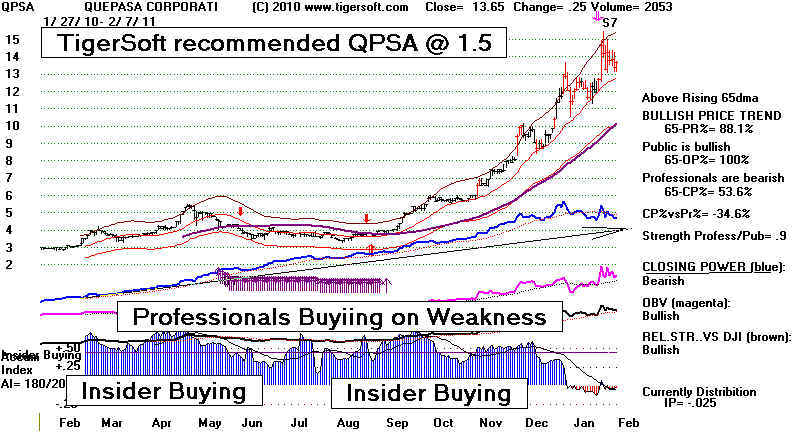
September 30, 2010 Biotechs
Showing Heavy Insider and Professional Buying August 14, 2010 APOLLO SHAREHOLDERS SHOULD BE MAD AS HELL ATPETER SPERLING's INSIDER SELLING! July 24, 2010 2010's Worst Performing Stocks and The Technical Factors That Predicted TheirDeclines January 26, 2010 Rampant Insider Selling Replaced Insider Buying in Goldman Sachs. Nov. 25, 2008 Easily Spot Key Insider Selling Using TigerSoft. January 9, 2008 Insider Selling Crunches Confidence in Shoe Stocks: January 6, 2008 - Insider Selling at Bear Stearns (BSC) and How TigerSoft Spots and Trades It. December 30, 2007 Insider Selling at Washington Mutual and CitiGroup December 27, 2007 Insider Selling at Quest in 2001-2003: Nov. 6, 2007 Lots of Stocks Look Like Good Short Sales September 7, 2007 The Lesson of ImClone: CEOs Should Not Be Trusted |
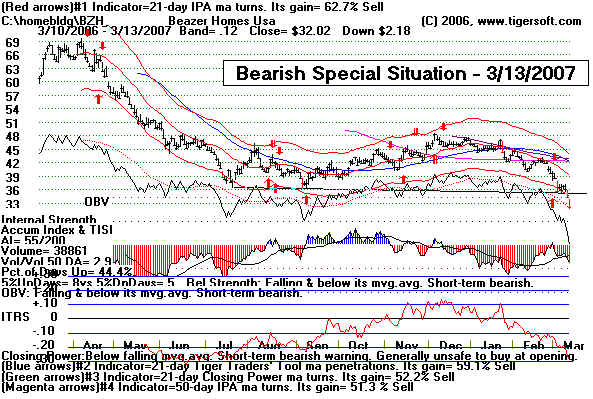
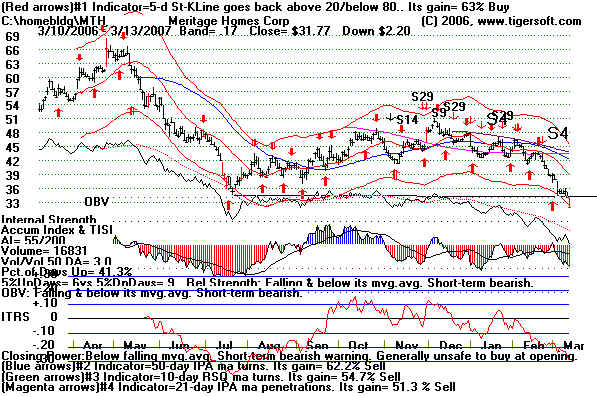
| Flagrant "Insider-Informed Selling" Apparent at Novastar Insiders and "Insider-Informed" Big Money knew of Criminal Investigation into mortgage lender - Novastar Financial - months before the public did. Tiger Software Users were apprised of the massive insider dumping as it fell below 20. Short positions were recommended. The stock has fallen 75% in two months. Perhaps, it was the outside lawyers who told the Big Holders of NFI to sell... Perhaps, it was the executives. Or their secretaries... We may never know. But the massive Big Money Distribution was very apparent on a Tiger Software chart of NFI. And some of our users are up 70% in two months here! 7/5/2007 - False takeover rumor planted. Trust TigerSoft instead. 11/14/2007 - NovaStar reports $598 million quarterly loss Subprime mortgage lender says shares may be de-listed from NYSE 12/11/2007 - Law Suit on NovaStar's mismanaged retirement account. On-Going Complaints about Nova Star's over-charging its borrowers. 12/19/2007 - Nova Star CEO, Scott Hartman, finally "retires". Scott Hartman ======================== NOVASTAR NFI ===================================== 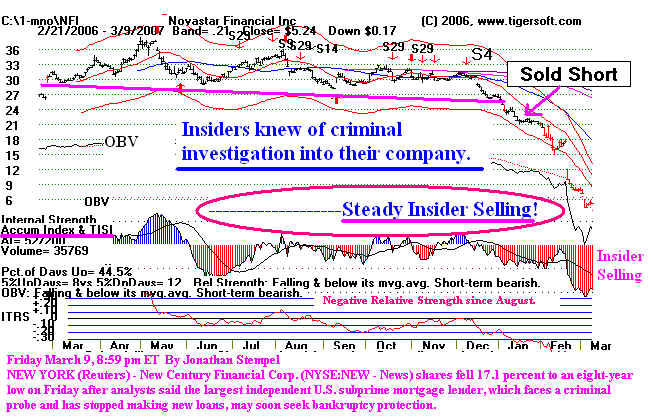 ------------------------ LEND ---------------------------------------------------------------------------------- 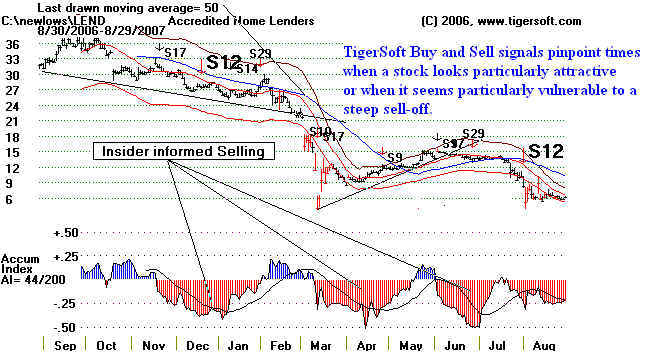 ============ HOUSING STOCK CARNAGE PREDICTED BY TIGERSOFT ========== 3/13/2007 ----- "Another Leg Down for Housing Stocks" The decline in these stocks spells big troubles for housing stocks generally. Our Tiger Index of 32 housing stocks looks ready to start another leg down. Note the false January peak. It showed a new high with the Tiger Accumulation Index negative. Traders who bought on the last short-term Buy are being forced to sell. A new low will be bearish for housing stocks and the whole market. Already a number of housing stocks are making new lows. They are the "leaders downward." ------------------------- Tiger Index of 32 Housing Stocks ---------------------------- 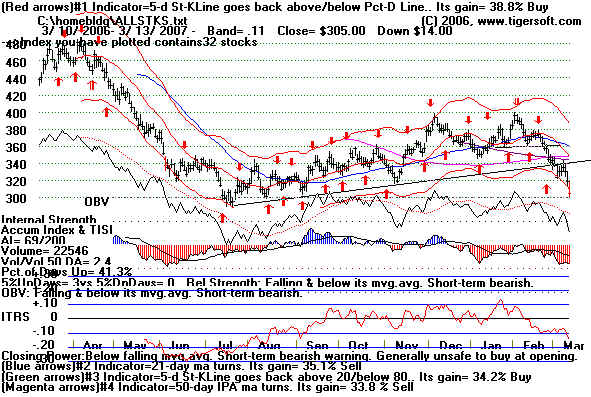
|